
How to Hunt Online Shopping Deals Without Getting Scammed
🛡️ Editorial Transparency Note: To keep this guide 100% honest, we want to clarify that we are not sponsored by any of the platforms listed below. If you want to see how we independently screen every discount we post, check out our master Tech Deals Hub.
Finding the best tech deals online in 2026 feels like searching for a needle in a haystack — except the haystack is on fire and half the needles are fake.
The US e-commerce market is now flooded with platforms that specialize not in saving you money, but in making you think you’re saving money. Fake countdown timers, inflated “original” prices, and shady dropshippers have made bargain hunting a minefield for even the most experienced shoppers.
That’s exactly why we built SifterDeals. We did the hard, tedious, unglamorous work of vetting, filtering, and testing these platforms so you don’t have to. In this guide, we’re pulling back the curtain on the best (and safest) places to find the best tech deals — and teaching you how to spot the fraudulent ones before they cost you.
Let’s get into it.
Quick Overview: The Best Tech Deals Platforms at a Glance
If you’re short on time, here’s the no-nonsense summary of the safest and most reliable platforms in the US market right now to get the best tech deals:
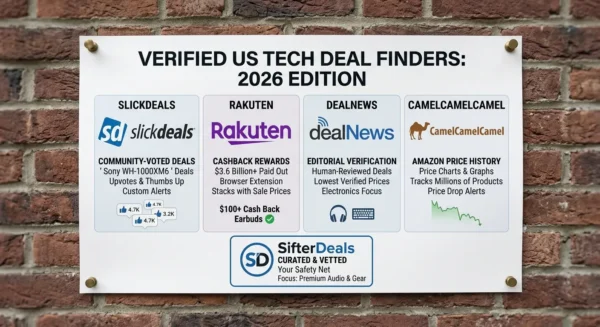
| Site | Best For | Free? | Why Trust It? |
| Slickdeals | All categories & community votes | ✅ Yes | 10M+ active community members |
| Rakuten | Cashback & store rewards | ✅ Yes | Over $3.6 Billion paid out to users |
| DealNews | Consumer electronics & gadgets | ✅ Yes | Human-verified deals since 1997 |
| CamelCamelCamel | Amazon price history tracking | ✅ Yes | Tracks millions of product histories |
Where to Find the Best Tech Deals: Platforms You Can Actually Trust
1. Slickdeals — The Community King
Slickdeals isn’t just a deals site. It’s a living, breathing ecosystem of millions of deal hunters who are, frankly, obsessed with getting the best tech deals on everything.
Here’s what makes it stand out from the crowd:
- Community-Voted Deals: Every deal is posted and upvoted by real users. If a deal is weak or misleading, the community buries it fast. This crowd-sourced quality control is something no editorial team can fully replicate.
- Custom Deal Alerts: Set an alert for “Sony WH-1000XM6” and Slickdeals will notify you the moment a verified best tech deals option appears. No more checking manually every day.
- Massive Category Coverage: Electronics, home goods, groceries, software subscriptions, even personal finance offers. If it goes on sale somewhere on the internet, Slickdeals will know about it.
- Discounts up to 100%: Yes, free is a discount. During peak sale seasons, Slickdeals surfaces legitimate freebies with purchase or sign-up.
Best for: Shoppers who want the broadest coverage and trust the wisdom of crowds over a single editor’s opinion.
2. Rakuten — Get Paid to Shop
Rakuten operates on a beautifully simple premise: shop through their portal, and they give you a cut of the commission they earn from retailers to secure the best tech deals. That cut is called cashback, and it adds up faster than you’d expect.
- $3.6 Billion Paid Out: Rakuten has paid over $3.6 billion in cashback to its members. That’s not a marketing number — that’s audited, verifiable revenue returned to shoppers.
- 32,000+ Trustpilot Reviews: With one of the highest review volumes of any cashback platform, Rakuten’s reputation is transparent and easy to evaluate.
- Browser Extension: Install it once, and it automatically activates cashback every time you shop at a supported retailer. Zero effort required.
- Stacks with Sale Prices: The smartest move? Combine a Rakuten cashback offer with a coupon code. You’re essentially getting a discount on top of a discount.
Best for: Regular online shoppers who want passive savings without changing their habits.
3. DealNews — The Editorial Standard
While Slickdeals crowdsources its deals, DealNews takes the opposite approach: a dedicated team of deal hunters manually verifies every single offer to deliver the best tech deals before they go live.
Founded in 1997, DealNews has nearly three decades of experience in knowing what real best tech deals look like versus a cleverly disguised non-deal.
- Human-Verified Listings: No algorithmic junk. Every posted deal has been reviewed by a real person.
- Price Focus: DealNews explicitly claims it only lists the lowest verified price from reputable retailers.
- Expert Blog: Beyond deals, their editorial content covers when to buy big-ticket items, which retailers have the best loyalty programs, and how to time your purchases strategically.
Best for: Shoppers who prefer editorial curation over community voting, especially for electronics and gadgets.
4. CamelCamelCamel — Your Amazon Price Truth Detector
This tool does one thing, and it does it better than anyone else: it shows you the complete price history of any product on Amazon so you can confirm you are actually getting the best tech deals.
Why does this matter? Because Amazon changes prices constantly — sometimes hundreds of times a day. What looks like a 40% discount today might actually be the product’s normal everyday price, with a temporarily inflated “original” price to make the deal look bigger than it is.
- Paste any Amazon URL into CamelCamelCamel and instantly see a price history chart going back years.
- Set Price Drop Alerts: Tell it the maximum price you’re willing to pay, and it emails you when the item hits that threshold.
- Completely Free: No subscriptions, no premium tiers. Just a reliable tool that has saved millions of shoppers from fake “deals.”
Best for: Anyone buying anything on Amazon over $30. Non-negotiable.
Answering Your Real Questions
How do I know if an online tech deal is legit?
Great question — and an increasingly important one when hunting for the best tech deals. Here’s a quick verification checklist:
- Check price history on CamelCamelCamel (for Amazon) or Google Shopping to confirm the “original price” isn’t manufactured.
- Look for HTTPS: A padlock icon in the browser bar means your payment data is encrypted. No padlock = walk away.
- Verify on Trustpilot: Spend 60 seconds reading recent reviews of the retailer. Look for patterns, not just the overall score.
- Cross-reference the MSRP: Check the manufacturer’s official website (Apple, Logitech, Samsung) for the real suggested retail price.
- Test the countdown timer: Open the deal in an Incognito window. If the timer resets, it’s fake urgency — a classic manipulation tactic.
What is the best day of the week to buy electronics online?
According to retail data patterns in the US market:
- Tuesday and Wednesday tend to see new weekly promotions go live, especially from major electronics retailers like Best Buy and B&H Photo.
- Sunday evenings are when Amazon frequently rotates its Lightning Deals inventory and pushes price updates ahead of the work week.
- Avoid impulse buying on Fridays: Retailers know that end-of-week psychology makes shoppers more likely to splurge. Friday “flash sales” are often less impressive than they appear.
The honest answer? The best day is the day you’ve done your price history research and the item has genuinely dropped to its historical low.
Are coupon browser extensions safe to use?
Tools like Honey (owned by PayPal) and Capital One Shopping are legitimate and widely used. But there are nuances worth knowing:
- Data Collection: Both extensions operate by reading your browser activity on retailer sites. If privacy is a concern, review their data policies before installing.
- Performance: Multiple active browser extensions can noticeably slow down page load times, especially on older machines.
- Code Database Gaps: These tools work brilliantly for major retailers like Amazon, Target, and Walmart. For niche or smaller tech brands, their coupon databases often come up empty.
- The Alternative: Bookmarking specialized deal pages (like SifterDeals) and checking before checkout gives you curated, direct links without any extension overhead.
⚠️ 5 Hidden Red Flags: How to Spot a Fake Tech Deal Site
Finding a good discount is great. Getting scammed is a nightmare. Before you click “Add to Cart” on an unfamiliar site looking for the best tech deals, make sure it isn’t waving any of these five warning signs:
1. The Endless Countdown Timer
If a product says “Deal expires in 12 minutes” but the timer resets every time you refresh the page — or disappears entirely in Incognito mode — it’s a psychological trap. Fake urgency is the oldest trick in the dropshipping playbook.
2. Inflated “Original” Prices
Shady retailers love to list a generic pair of earbuds at $300, then offer a “90% discount” making it $30. Always cross-check the baseline price on official brand sites or Google Shopping. If the “original price” doesn’t exist anywhere else on the internet, it was invented.
3. Missing HTTPS Security
Check the URL bar. If it starts with http:// (no “S”) or shows a broken padlock icon, your payment information is not encrypted. This is a fundamental security requirement, not an optional feature. Never enter credit card details on an unsecured site.
4. Zero Price History
Legitimate deal platforms and price trackers show you when the price actually dropped. If a site claims it’s a “today-only flash sale” with no historical data to back it up — no charts, no comparisons, no references — treat it as unverified.
5. A Trustpilot Score Below 3.5 (or No Presence at All)
Before buying from any unfamiliar platform, run a 30-second Trustpilot check. A score below 3.5, a suspiciously small number of reviews for an “established” store, or zero presence at all are serious signals. Don’t volunteer to be someone’s learning experience.
How SifterDeals Fits Into Your Shopping Strategy
Here’s the honest problem with the platforms we’ve covered: they’re enormous.
Slickdeals alone lists thousands of deals every day. Rakuten covers over 3,500 retailers. DealNews spans every product category imaginable. For someone who just wants to find the best tech deals on a pair of wireless earbuds or a Logitech gaming mouse, the experience can quickly become overwhelming.
That’s the gap SifterDeals was built to fill.
We take the firehose of deals from these verified giants, filter it down to the categories our readers actually care about — premium audio, professional gaming peripherals, mobile accessories, and smart home gear from brands like Logitech, Sony, and Bose — and present them in one clean, organized place.
Think of us as the layer of curation that sits on top of the curation. We don’t replace Slickdeals or Rakuten. We make them more useful for you.
The Smart Shopper’s Calendar: When to Buy What
In the US retail market, timing is as important as where you shop to score the best tech deals. Mark these windows on your calendar:
🗓️ January — Post-Holiday Clearance
Retailers are desperate to move overstock from the holiday season. This is consistently one of the best windows for audio gear, fitness gadgets, and tech accessories that didn’t sell during Christmas.
🗓️ July — Amazon Prime Day (and the Counter-Sales)
Amazon’s summer mega-event triggers a competitive response from Best Buy, Walmart, and Newegg. The best Prime Day strategy? Watch what competitors are doing. Smart home devices, wireless headphones, and tablets routinely hit their annual lowest prices during this window.
🗓️ August — Back to School
Officially marketed to students, realistically open to everyone. Deep discounts on laptops, mechanical keyboards, monitors, and productivity setups are standard during this period.
🗓️ November — Black Friday & Cyber Monday
The undisputed king of discount seasons. This is when flagship electronics, gaming gear, and premium audio equipment hit their historical price floors. If you’re planning a major tech purchase and it’s not urgent — wait for November to get the absolute best tech deals.
Before You Buy: The 60-Second Safety Checklist
Don’t let a “limited-time offer” rush you into a bad decision. Before you type in your credit card details, run through this quick verification:
- [ ] Historical Price Check — Did I look up the product on CamelCamelCamel or Google Shopping to confirm this is an actual discount, not a seasonal price hike?
- [ ] Connection Security — Does the URL start with
https://and show a padlock icon in the address bar? - [ ] Reputation Audit — Did I spend 30 seconds checking the store’s latest reviews on Trustpilot?
- [ ] Urgency Verification — Is the countdown timer legit, or does it reset when I open the link in an Incognito window?
- [ ] Baseline Cross-Check — Did I verify the “Original Price” against the manufacturer’s official MSRP?
- [ ] Double-Dip Savings — Did I check for an active Rakuten cashback offer for this retailer before checking out?
If you can check all six boxes, you’re ready to buy with confidence. If even one raises a flag — keep looking.
💬 Join the Hunt: Online shopping algorithms change constantly. Have you spotted a new retail red flag recently? Drop a comment below! Also, if you want to see our safety tips applied in real-time, don’t miss our latest deep-dive testing the best Logitech Gear Discounts for this month.
Frequently Asked Questions
Q: Is Slickdeals completely free to use?
A: Yes. Slickdeals is 100% free for shoppers. The platform earns revenue through affiliate commissions when users click through to purchase, but this doesn’t affect the deals listed or the community voting system.
Q: How often does Amazon actually have genuine price drops?
A: Amazon’s pricing algorithm updates continuously — sometimes hundreds of times per day for popular products. Genuine drops do happen regularly, but they’re often short-lived. Setting a CamelCamelCamel alert is the most reliable way to catch them at the right moment.
Q: Can I combine Rakuten cashback with a coupon code?
A: In most cases, yes. This “double-dipping” strategy — applying a promo code at checkout while routing your purchase through Rakuten — is completely legitimate and one of the most effective ways to maximize savings.
Q: What makes a deals site trustworthy versus sketchy?
A: The three core signals are: verified Trustpilot presence (score above 3.5 with substantial reviews), transparent affiliate disclosure, and measurable price history data. Any site missing all three deserves serious skepticism.
Q: Are all flash sales worth acting on immediately?
A: No. Genuine flash sales on products with verifiable price history are worth acting on. “Flash sales” on products with no traceable price history, from sites with no reviews, are almost always marketing theater.
The Bottom Line
The golden rule of smart online shopping in 2026 is simple: never pay full price, but never trust a deal you haven’t verified.
The platforms in this guide — Slickdeals, Rakuten, DealNews, and CamelCamelCamel — have collectively earned their reputations through years of consistent, transparent operation. Use them. Combine them. Let them work together.
And when the sheer volume of deals becomes overwhelming, that’s what SifterDeals is here for — to filter the noise and surface what actually matters for the gear you care about.
Happy hunting.
Join the Hunt: Online shopping algorithms change constantly. Have you spotted a new retail red flag recently? Drop a comment below! Also, if you want to see our safety tips applied in real-time, don’t miss our latest deep-dive testing the best best wireless earbuds 2026 guide for this month.
