
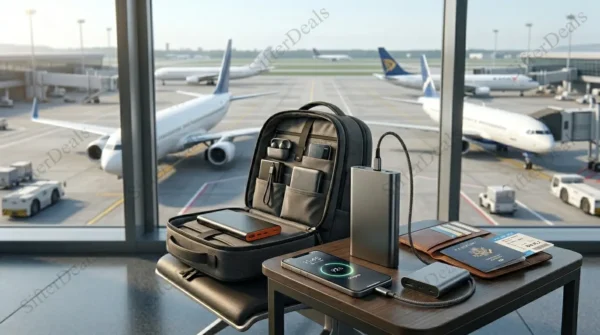
Traveling in 2026 puts more demand on your battery than ever before. Boarding passes live on your phone. Hotel check-ins, navigation, translation apps, ride bookings — all of it runs through a screen. Add a long-haul flight, a layover that turned into three hours, and a dead laptop you planned to work on, and suddenly a power bank isn’t a nice-to-have. It’s the reason your trip doesn’t fall apart.
The problem isn’t that good travel power banks don’t exist. It’s that finding one that’s actually travel-ready — meaning compact enough to carry all day, fast enough to matter during a 20-minute layover, safe to fly with, and reliable enough that you trust it — takes more sorting than most people want to do.
This guide focuses on exactly that. We looked at portability, airline compliance, fast charging, and real-world reliability. Every pick is verified against manufacturer specifications, TSA and IATA guidelines, and trusted technical sources. No guesswork, no inflated claims.
If you’re searching for the best travel power banks 2026, here’s what’s actually worth packing.
→ For the full roundup of every category, see our Best Power Banks 2026 – Complete Buying Hub.
What Makes a Good Travel Power Bank in 2026?
Not every power bank is built for travel. A high-capacity unit that’s great on your desk can be the wrong choice in a carry-on. Travel changes the priorities entirely.
The difference between a regular power bank and a travel power bank comes down to a few practical factors. Size and weight matter more on the road than at home. Carrying something heavy through an airport all day, or trying to fit an oversized brick into a jacket pocket while boarding, reminds you quickly why compact design earns its own category. The best travel picks balance meaningful capacity with a form factor that doesn’t punish you for bringing it.
USB-C Power Delivery has become the non-negotiable minimum. In 2026, nearly every phone, tablet, and ultrabook charges via USB-C PD. A travel power bank without it isn’t keeping pace with modern devices. Look for at least 20W output for phones, 45W for tablets and light laptop top-ups, and 65W or above if you regularly travel with a laptop.
Fast input charging matters just as much as output speed. A power bank that takes six hours to recharge itself from a hotel outlet creates a problem on back-to-back travel days. Models that accept 45W or higher input via USB-C PD can typically recharge overnight without issue.
Multiple ports solve the “who charges first” problem when you’re traveling with more than one device — or traveling with a partner.
For capacity, the useful rule of thumb is: 10,000mAh for day trips, city breaks, or short domestic flights; 20,000mAh for multi-day trips, long-haul flights, and anyone charging more than a phone. Most standard lithium-ion power banks operate at 3.7V, so 10,000mAh ≈ 37Wh and 20,000mAh ≈ 74Wh — both well within the airline threshold.
That threshold matters. Airlines regulate power banks based on watt-hours (Wh), not mAh. Units under 100Wh are generally allowed in carry-on luggage without special approval. Every pick in this guide is under 100Wh.
Airline Rules You Need to Know
Before you pack, the rules are straightforward — but they come with important caveats.
Per TSA guidelines, lithium-ion power banks must be carried in carry-on luggage only. They are not permitted in checked baggage. This applies regardless of size. The reason is safety: if a lithium battery malfunctions or catches fire, cabin crew can respond. In the cargo hold, that’s not possible.
The capacity limits work like this: units under 100Wh are allowed without airline approval. Units between 100Wh and 160Wh may be permitted but typically require airline approval and are usually limited to two per passenger. Anything above 160Wh is prohibited on commercial passenger flights.
To calculate Wh from mAh: multiply the mAh rating by the battery voltage (usually 3.7V for lithium-ion) and divide by 1,000. A 20,000mAh power bank at 3.7V = 74Wh. A 25,000mAh unit = 92.5Wh. Both are under the 100Wh limit. The labeled Wh rating on the unit itself is the authoritative number if one is printed.
One important note: individual airline policies can vary, particularly on international routes. Some carriers in Asia and Europe enforce additional restrictions, especially for power banks above 20,000mAh. Always check your specific airline’s lithium battery policy before you fly. The TSA and IATA set the floor; airlines can add restrictions on top.
What to Look for in a Travel Power Bank
Lightweight Design
Every gram you add to a carry-on or day bag compounds over the course of a trip. A 10,000mAh power bank around 160g disappears into a jacket pocket. A 20,000mAh unit around 350–400g sits comfortably in a backpack side pocket. Anything heavier than that is worth reconsidering unless you specifically need laptop-level output. Weight is always a tradeoff against capacity — know which matters more for your trip before you buy.
USB-C Power Delivery
USB-C PD is the universal fast-charging standard for modern devices. Per USB-IF specifications, PD-enabled devices negotiate the fastest safe charging speed automatically. Without PD, you’re limited to slow 5W–10W output regardless of what the power bank advertises on the box. In 2026, no travel power bank is worth carrying if it doesn’t support USB-C PD on at least one port.
Fast Input Charging
A power bank that accepts 20W or higher input via USB-C PD can recharge itself overnight at a hotel without problem. Models with 45W input can go from low to full in roughly two hours — useful when you have a short layover with access to a wall outlet. Always pair fast-input models with a compatible wall charger; the power bank charges only as fast as what you plug it into.
Multiple Ports
For solo travelers, two ports — one USB-C and one USB-A — covers most scenarios. For people who travel with a partner or carry a phone, earbuds, and tablet simultaneously, three ports is the practical minimum. Keep in mind that when multiple ports are in use, total output is shared — a 45W power bank running two ports simultaneously will distribute that wattage across both devices, not deliver 45W to each.
Battery Capacity: 10,000mAh vs 20,000mAh
A 10,000mAh power bank delivers approximately 6,000–7,000mAh of usable power to your device after accounting for voltage conversion losses — enough for one to two full smartphone charges, depending on your phone’s battery size. That’s the right call for day trips, short flights, and light travelers.
A 20,000mAh unit delivers roughly 12,000–14,000mAh of usable power — enough for three to four smartphone charges, one to two tablet sessions, or a meaningful top-up for a light laptop. If you’re going longer than two days or charging more than your phone, the 20,000mAh tier is worth the extra weight.
Our Top Picks for Best Travel Power Banks 2026
Best Overall Travel Power Bank — INIU Pocket Rocket P50 (10,000mAh, 45W)
~$33 | 10,000mAh | 45W output | PD 3.0 / QC 3.0 / PPS | ~37Wh | Weight: 160g (5.6 oz)
The Pocket Rocket P50 solves the fundamental tension in travel power banks: serious charging speed in a package small enough that you’ll actually bring it. Listed on INIU’s official store at iniushop.com, the P50 uses INIU’s proprietary TinyCell Pro battery technology, which makes it approximately 45% smaller than a standard 10,000mAh power bank according to INIU’s specifications, while the 45W output keeps it competitive with wall chargers twice its size.
Per INIU’s testing data, it can bring a smartphone to around 73% in approximately 25 minutes under optimal conditions. It supports PD 3.0, QC 3.0, and Samsung Super Fast Charging 2.0 (PPS), covering the fast-charge protocols used by most flagship phones in 2026. Three ports — two USB-C and one USB-A — let you run multiple devices without juggling connections.
At 160g (5.6 oz) and measuring just 3.3 × 2.0 × 1.0 inches, it fits in a jacket pocket without bulk. The detachable lanyard-integrated USB-C cable means one fewer thing to pack. At ~37Wh, it’s among the most comfortable power banks to bring through airport security with zero documentation concerns.
The 18-layer SmartProtect safety system covers overcharge, short-circuit, overcurrent, and thermal protection. INIU backs it with a 3-year warranty.
Best for: Day trips, city travel, short to medium flights, solo travelers who want fast charging without the bulk.
| Spec | Detail |
|---|---|
| Capacity | 10,000mAh |
| Output | Up to 45W (USB-C) |
| Ports | 2× USB-C + 1× USB-A |
| Input | USB-C (up to 20W) |
| Weight | 160g (5.6 oz) |
| Wh | ~37Wh ✈️ |
| Warranty | 3 years |
Charging speeds vary depending on device compatibility, cable quality, and conditions. Performance estimates are based on manufacturer specifications.
Best Travel Power Bank for Long Flights — Baseus EnerFill FC11 (20,000mAh, 45W)
~$40 | 20,000mAh | 45W output | Dual built-in USB-C cables | ~74Wh
Long-haul flights are where capacity stops being a luxury and starts being a necessity. Eight hours in the air with a phone, tablet, and a pair of wireless earphones all draining simultaneously is exactly the kind of scenario this pick is designed for.
The EnerFill FC11 is Baseus’s 2026 20,000mAh travel model, released in the US in January 2026 and listed on Baseus’s official store at baseus.com. The headline convenience feature is dual built-in USB-C cables — one longer (approximately 7 inches) and one shorter (approximately 4 inches). You can leave your charging cables at the bottom of your bag and run both cables directly from the power bank itself, charging two devices simultaneously without untangling anything.
Per Baseus specifications, the 45W output can bring a recent flagship iPhone to around 67% or a Samsung S25 Ultra to around 60% in approximately 30 minutes under optimal conditions. Four-device simultaneous charging (two built-in cables plus two external ports) makes it one of the most practically useful setups for group travel. The smart digital display shows remaining battery percentage clearly.
At ~74Wh, it’s well within airline carry-on limits. Baseus confirms this model is airline-approved for carry-on.
Best for: Long-haul flights, multi-day trips, travelers charging multiple devices, anyone who wants to eliminate extra cables.
| Spec | Detail |
|---|---|
| Capacity | 20,000mAh |
| Output | Up to 45W (USB-C) |
| Ports | 2× built-in USB-C + 2× external ports |
| Input | USB-C fast input |
| Weight | ~350g (approx.) |
| Wh | ~74Wh ✈️ |
| Price | ~$40 |
Charging speeds vary depending on device compatibility, cable quality, and conditions. Performance estimates are based on manufacturer specifications.
Best Slim Travel Power Bank — Baseus EnerCore CR11 (10,000mAh, 45W)
~$30 | 10,000mAh | 45W output | Built-in retractable USB-C cable | ~37Wh
If the priority is the smallest possible footprint with as few loose parts as possible, the EnerCore CR11 is the answer. Its retractable USB-C cable extends on pull and retracts flush with the body — no loops, no snagging, nothing flopping around in your bag. For minimalist travelers, this removes one entire category of thing to remember.
The smart LED display shows exact battery percentage, which is more useful during travel than a vague 4-dot indicator: you know exactly whether you have enough charge for the flight before you even get to the gate. Dual heat dissipation with graphene layers and aerospace-grade aerogel insulation gives the CR11 a more engineered thermal system than most competitors at this price.
Per Baseus’s listed specifications, the 45W output can bring an iPhone 16 Pro to around 60% in approximately 30 minutes under optimal conditions. At just ~37Wh, it’s one of the most comfortable options for air travel from a documentation standpoint.
Best for: Minimalist travelers, light packers, anyone who wants one less cable to carry.
| Spec | Detail |
|---|---|
| Capacity | 10,000mAh |
| Output | Up to 45W (USB-C) |
| Ports | Retractable USB-C + 1× USB-A |
| Input | USB-C |
| Wh | ~37Wh ✈️ |
| Warranty | 24 months |
Charging speeds vary depending on device compatibility, cable quality, and conditions. Performance estimates are based on manufacturer specifications.
Best Travel Power Bank for Laptops — Anker 737 (24,000mAh, 140W)
~$95–$100 | 24,000mAh | 140W output (PD 3.1) | 86.4Wh | Weight: ~22 oz (1.39 lb)
Charging a laptop from a power bank requires more than high mAh. It requires enough wattage for the device to actually charge — not just slow down its drain. The Anker 737 is one of the few power banks in 2026 that delivers 140W via USB Power Delivery 3.1, which is sufficient to charge even high-draw laptops like the MacBook Pro 16 at meaningful speed.
Per TechRadar’s independent testing, the 737 delivers stable voltage output under load, which matters when you’re running a laptop and a phone simultaneously. Both USB-C ports support the full 140W rating individually, not just one. The OLED display shows real-time per-port input and output wattage — genuinely useful when managing multiple devices mid-flight.
The 24,000mAh / 86.4Wh capacity is verified to be under the 100Wh airline carry-on threshold, and Anker confirms the 737 meets TSA carry-on requirements. It measures 6.1 × 2.1 × 1.9 inches and weighs approximately 22 oz — this is not a pocket device. It belongs in a backpack, which is the right carry for anyone traveling with a laptop anyway.
Per StorageReview’s testing, real-world efficiency at 140W runs at approximately 85% of rated capacity, and at 100W approximately 89%, which is strong for a battery at this output level.
Note: To reach 140W input or output, a compatible PD 3.1 cable and device are required. Per Anker’s specifications and StorageReview’s testing, the 737 can recharge itself in approximately one hour under optimal 140W charging conditions, and in approximately 1.5 hours at 100W input — both workable for overnight recharging at a hotel.
Best for: Remote workers traveling with a laptop, anyone running multiple high-draw devices, long business trips.
| Spec | Detail |
|---|---|
| Capacity | 24,000mAh |
| Output | Up to 140W (PD 3.1, USB-C) |
| Ports | 2× USB-C + 1× USB-A |
| Input | Up to 140W (USB-C) |
| Weight | ~22 oz (1.39 lb) |
| Wh | 86.4Wh ✈️ |
| Warranty | 24 months |
Achieving 140W output requires a compatible PD 3.1 cable and a device that supports PD 3.1 input. Real-world laptop charging speed will vary depending on the laptop’s maximum input wattage. Performance estimates are based on manufacturer specifications and third-party testing.
Quick Comparison Table
| Model | Capacity | Max Output | Wh | Price | Best For |
|---|---|---|---|---|---|
| INIU Pocket Rocket P50 | 10,000mAh | 45W | ~37Wh ✈️ | ~$33 | Overall travel pick |
| Baseus EnerFill FC11 | 20,000mAh | 45W | ~74Wh ✈️ | ~$40 | Long flights |
| Baseus EnerCore CR11 | 10,000mAh | 45W | ~37Wh ✈️ | ~$30 | Slim/minimal carry |
| Anker 737 | 24,000mAh | 140W | 86.4Wh ✈️ | ~$95–$100 | Laptop travel |
All units are under 100Wh and airline-safe for carry-on per TSA guidelines. Always verify with your specific carrier before flying. Prices are approximate as of May 2026.
Common Travel Power Bank Mistakes
Bringing Oversized Batteries
It’s tempting to maximize capacity. But a power bank above 100Wh requires airline approval that many carriers won’t grant at the gate, and anything above 160Wh is banned from passenger flights entirely. Sticking to units under 100Wh removes this variable completely. All four picks on this list are under 87Wh — safely clear of any airline threshold.
Ignoring Weight
A 1.4 lb power bank sounds reasonable until you’ve carried it through three airports in two days. For phone-and-tablet travelers, a sub-200g model covers almost every scenario and costs nothing in comfort. Save the heavier units for trips where you genuinely need laptop-level output.
Buying Slow-Charging Models
A 5W or 10W power bank in 2026 is a frustration device. In a 20-minute boarding window, 5W adds maybe 5–7% to a modern phone. A 45W model might add 30–40% in the same window, depending on device compatibility. The difference is not marginal — it’s the gap between useful and useless during a layover.
Forgetting the Cable
Built-in cables solve this problem entirely, which is one reason the INIU P50, Baseus EnerCore CR11, and EnerFill FC11 all ship with them. If your power bank requires an external cable, pack a short, high-quality USB-C cable specifically for travel and keep it with the power bank. Cable quality affects actual charging speed — a low-quality cable can prevent a device from negotiating higher PD wattages.
Frequently Asked Questions
Can I bring a power bank on a plane?
Yes, with conditions. Per TSA guidelines, power banks must be in carry-on luggage only — not checked bags. Units under 100Wh are generally allowed without airline approval. Units from 100Wh to 160Wh may be allowed with advance airline approval. Anything above 160Wh is prohibited on passenger flights. Always confirm with your airline before you fly, as individual carrier policies can add restrictions beyond the TSA baseline.
What capacity is best for travel?
For day trips or short flights: 10,000mAh. For multi-day trips, long-haul flights, or charging multiple devices: 20,000mAh. For travelers who need to charge a laptop: 20,000–25,000mAh with at least 65W output. More capacity is not always better — it comes with more weight and more to carry through security.
Are power banks allowed internationally?
Most international airlines follow IATA guidelines, which align closely with TSA rules: under 100Wh in carry-on, no checked baggage. That said, some carriers — particularly in parts of Asia — enforce stricter limits or cap the number of power banks per passenger. Before any international flight, check the airline’s lithium battery policy directly on their website.
Is fast charging important while traveling?
Yes, especially in situations where charging time is limited: boarding windows, short layovers, or a taxi to the next location. A 45W power bank can restore meaningful charge in 20–30 minutes. A 5W power bank in the same window barely moves the needle. If you’re traveling, fast charging is the feature most likely to make a practical difference.
Final Thoughts
The best travel power bank isn’t the one with the biggest mAh number. It’s the one you’ll actually bring — light enough to carry all day, fast enough to help during a short window, and safe to fly with without any extra documentation or negotiation at the gate.
For most travelers, the INIU Pocket Rocket P50 is the right balance: pocket-sized, 45W output, and ~37Wh so it passes through every airport without a second glance. If you need 20,000mAh with built-in cables for a long-haul flight, the Baseus EnerFill FC11 covers that tier cleanly. And if you travel with a laptop and need real wattage, the Anker 737 is the pick that won’t let you down.
All three priorities — portability, charging speed, and airline safety — can be met in 2026 without compromise. You just need to know which product serves which trip.
→ For the full roundup of every category, see our Best Power Banks 2026 – Complete Buying Hub.
